
30 Minutes of Childhood: Why Reading Aloud Is the Language Hack Nobody Wants to Use
I. The Bathtub in Paris
No, not Jean-Paul Marat, but me in the bathtub. Forgive the visual, but I remember spending hours in the bathtub reading. I recall it still: while I was studying languages and international politics in Paris, those evenings that chiseled, carved, and hewed my 19 year old brain. The apartment was small, the water drifting degree by degree toward tepid, and I read- out loud, to no one, with full theatrical commitment. I read exagérément, both in terms of quantity and articulation. Novels, mostly. Romain Gary, Marguerite Duras, Kundera. Some articles assigned in class. The occasional poem I didn’t fully grasp, but liked the sound of. I would hear myself stumble over a subjunctive, back up, try again. I was, without quite knowing it, doing something very important.
Years later, people would tell me my French accent was imperceptible. I like to think it was the bathtub.
Now, I want to be careful here. Accent is a topic that deserves its own full reckoning (and I’ll give it one another day), but for now I’ll say this: language learners spend an inordinate amount of energy fretting over their accents, and accent is, in fact, only a fraction as important as most people believe. What is important — what actually changes the way you process, produce, and inhabit a language — is something far simpler, far less glamorous, and far less popular as advice: reading out loud.
Before the cringe overwhelms you and you make a hasty exit from this page, bear with me.
II. The Accent Paradox (A Brief Detour)
There’s a strange irony in the world of language learning. Ask any learner what they most want to improve, and the answer is almost always: my accent. Accent is the thing that feels most exposed, most vulnerable, most foreign. It’s the part of us that announces, even before we’ve finished our sentence, that we are from somewhere else. And for those most directly victim of glottophobia, that can rightfully be terrifying!
And yet accent is one of the things least amenable to direct attack. You cannot simply decide to have a better accent and practice your way there through sheer force of will and YouTube tutorials. Phonological acquisition is slow, embodied, and largely unconscious. It happens in the margins — in the grooves worn by hours of exposure and production, not in the spotlight of anxious self-monitoring.
What does work — what actually moves the needle on the full suite of things that make a speaker sound natural — is, among other things, reading aloud. But more on that later. The point here is simply: accent is a byproduct of a much larger process, and that process is what we’re really talking about.
III. Reading Aloud for Language Learners
Let’s start with the obvious and work our way to the surprising.
When you read silently, you are, broadly speaking, a passive receiver. Your brain processes meaning, follows narrative, decodes grammar — but it does so from the comfortable distance of comprehension. When you read aloud, something different happens: you are forced to perform the language. Every word has to leave your mouth. Every syllable has to be committed to. You cannot skim. You cannot glide past the word you don’t quite know how to say. You have to say it. This is not merely inconvenient. It is, in fact, the point.
Research confirms what seasoned language teachers have long suspected: reading aloud produces measurable improvements in pronunciation accuracy, phonemic awareness, and overall linguistic competence. A 2025 study published in the JOLLT Journal of Languages and Language Teaching examined the effect of reading aloud on EFL students’ ability to handle one of English’s most notorious quirks: silent letters. Words like knight, psychology, doubt — the kind that make historical linguists giddy with delight, and learners feel the language is conspiring against them. The results were striking: students who practiced reading aloud showed a measurable improvement in both pronunciation accuracy and awareness, with nearly 90% reporting that the technique helped them tackle silent letter pronunciation, while also deepening their sensitivity to phonetic nuance more broadly.
This matters because silent letters are not an edge case in English — they are everywhere, and they are a reliable source of the kind of pronunciation errors that are genuinely hard to shake once they become habitual. Getting them right early, through the physical act of reading them aloud correctly, is one of the most efficient investments a language learner can make.
But beyond the mechanics of individual sounds, reading aloud trains something subtler and arguably more important: rhythm. Every language has a pulse — a characteristic pattern of stress, intonation, and flow that native speakers recognize instantly and non-native speakers often miss. Reading aloud forces you to engage with that pulse in real time, to feel where the stress falls in a sentence, to hear yourself when you get it wrong. It is, in the most literal sense, practice for speaking — without the social stakes of an actual conversation.
There is also the matter of what reading aloud does to your relationship with written text. Researchers who have studied reading practices in foreign language contexts have noted that reading aloud encourages learners to slow down, to attend to words and structures they might otherwise skip over, and to develop a more active relationship with the text. The language becomes something you do, not just something you receive.
IV. What Happens in the Brain
If the language-learning benefits of reading aloud are compelling, the cognitive science is almost unfair in its clarity.
In 2017, researchers Colin MacLeod and Noah Forrin at the University of Waterloo published findings that put a name to something psychologists had been observing for years: the production effect. Reading words aloud makes them significantly easier to remember than reading them silently — because verbally pronouncing a word creates a memorable, distinct experience, and the active process of encoding a word into speech also helps encode it into long-term memory.
The mechanism is elegant. Hearing your own voice provides a distinct stimulus of self-recognition, which adds another layer of memorability to the content. When you read silently, the experience of each word is largely uniform. When you read aloud, each word becomes an event — something you did, something you said, something attached to the particular moment of your own voice producing it. By engaging both the motor system and self-recognition, speaking words aloud encodes them as unique experiences by forming additional memory pathways — a finding that is also consistent with research showing that movement and exercise can promote cognitive performance by increasing blood flow to the brain.
Subsequent research has extended the production effect beyond individual words to full passages of text. When participants read passages aloud rather than silently, they showed a consistent benefit on memory-focused questions, confirming that production improves memory not just for isolated words but for extended text as well.
What this means for the language learner, and for anyone trying to truly absorb what they read, is significant. The bathtub hours in Paris were not just pleasant immersion. They were, neurologically speaking, an unusually efficient form of encoding. I wasn’t just reading French. I was making French, over and over, until the words belonged to me.
There is something almost radical about this implication: the habit that sounds the most childish (reading out loud like a first-grader sounding out words) turns out to be one of the most cognitively sophisticated things an adult reader can do.
V. Reading Aloud as Social Ritual
So far we’ve been treating reading aloud as a solo practice; a private discipline, a bathtub habit. But some of its richest possibilities are social.
Think of a script read-through. A room of people, each taking a role, moving through a play or a screenplay out loud together. What’s happening in that room is not just performance preparation, it is a collective act of language, full of timing, listening, laughter, and improvised emphasis. You hear how other people inhabit the same words differently. You discover that language is not fixed on the page but alive in the mouth.
The same principle applies in language classrooms, book clubs, and anywhere people gather around a text. Reading aloud in a group transforms the experience of a written work into something shared and embodied — something closer to conversation than consumption. And then there is the teacher reading aloud to students.
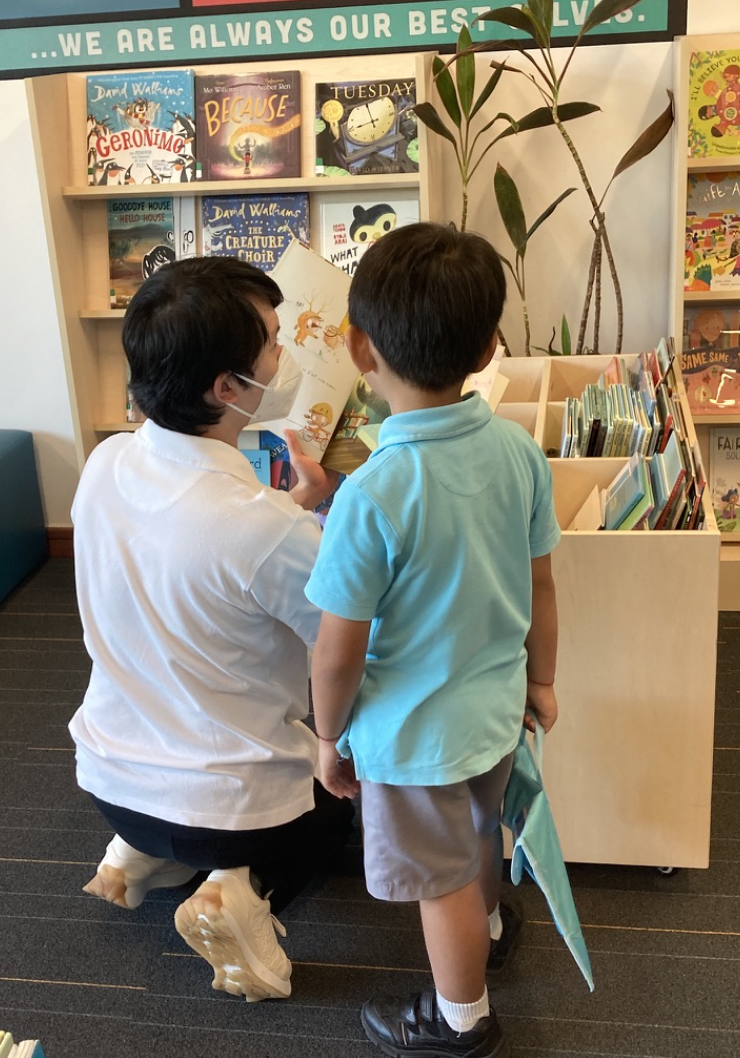
I used to tell my students — often 11th graders, sixteen and seventeen years old, entirely convinced they were too cool for most things — that we were going to have 30 minutes of childhood. I would pull out a book. They would, with varying degrees of theatrical reluctance, make their way to the carpet. And I would read to them. What happened next was, every single time, a small miracle.
Within minutes, the performative indifference would dissolve. They would lean in. They would laugh at the right moments. They would go quiet in a particular way that meant something had landed. The language in the book — the rhythm of it, the imagery, the themes — reached them through the voice and the shared space in a way that silent individual reading, however valuable, simply could not replicate. We were goofy together. We returned, without embarrassment, to the comforts of childhood. And we engaged with story, language, and theme in what I can only describe as a no-stress, low-pressure way that the formal apparatus of literary analysis often destroys.
This is not, it turns out, a sentimental indulgence. Experts in literacy have made the case, forcefully, that read-alouds should not be the exclusive province of early childhood education. Reading aloud is not just a pleasurable pastime rooted in oral tradition — it is an effective academic tool that parents and teachers tend to overlook once children reach the age when they can read on their own.
VI. An Invitation, Not a Prescription
I am not going to tell you that reading aloud will solve all your language problems. I am not going to promise you an imperceptible accent — though I maintain that the bathtub years were not irrelevant.
What I will say is this: if you are learning a language, and you are not reading aloud regularly, you are leaving something significant on the table. Not because a teacher told you to. Not because it appears on some official curriculum. But because speaking a language, even to yourself, even to no one, even in a bathtub in Paris at the age of nineteen, is how you make it yours.
The voice does something the eye alone cannot. It slows you down, forces commitment, creates memory, and — in the right room, with the right people, on the right afternoon — builds the kind of shared experience around language that reminds you why you wanted to learn it in the first place.
Find your carpet. Find your book. Give yourself 30 minutes of childhood.